
Sending a file feels effortless. Pull out your phone, tap share, and a photo is halfway around the world before you can put it back in your pocket. Consumer file sharing is one of those quietly miraculous things we’ve all stopped noticing.
But if you’re running IT for a bank, a healthcare system, or a global manufacturer, the experience on your end looks nothing like that. Behind the scenes, the way large organizations move sensitive data is surprisingly fragile and shockingly expensive. Most companies don’t realize how badly they’ve been trapped until the renewal invoice lands.
The Tax on Hiring
Here’s a scenario that’s more common than you’d think. A fintech company signs up with a traditional SaaS file transfer vendor. The pricing seems reasonable at first. Then their team grows, which is supposed to be a good thing, and over two years, their monthly bill has ballooned to the point where someone flags it in a budget review. The problem wasn’t that they were using fancy new features or moving vastly more data. The bill went up because they hired more people.
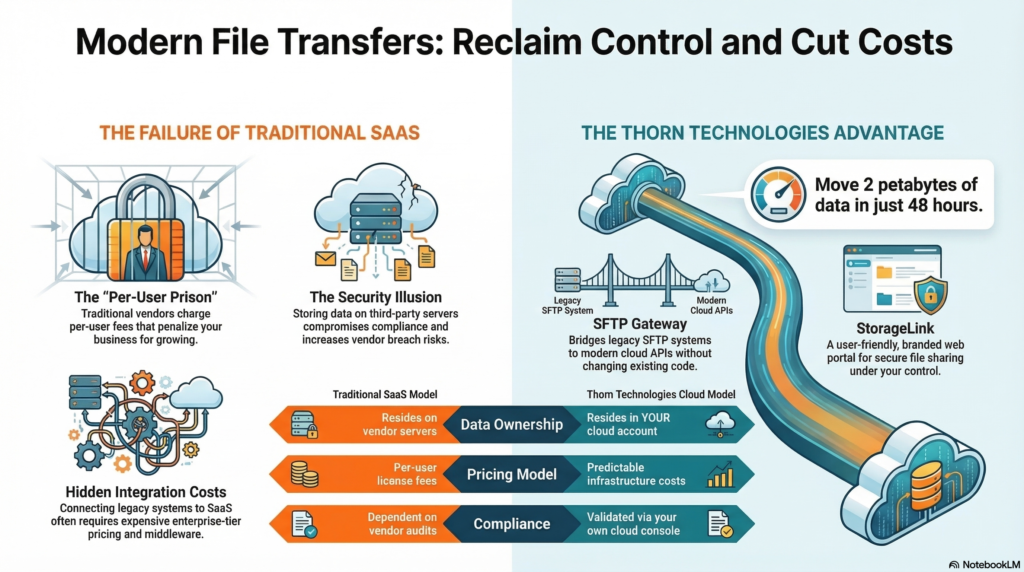
That’s the per-user pricing trap. Every new employee who needs file access is another monthly license fee. Bring in an outside auditing firm for a two-week engagement? That’s another recurring charge just to give them a login, regardless of whether they transfer one spreadsheet or 100 gigabytes of data. The pricing model punishes growth. It’s effectively a tax on hiring.
A global manufacturer ran into this the other way around. They needed a system to support 500 users across a worldwide network, not heavy power users, just employees who occasionally needed to securely send or receive a file. The quote they received from a traditional vendor was, by their own description, impossible to take seriously. The vendor was pricing 500 basic user accounts as if they were 500 enterprise software installations.
This is what happens when a pricing model was never actually built for scale. It was built to lock organizations into a recurring revenue stream that gets heavier the more embedded it becomes.
The Security Illusion
Financial pain gets a CFO’s attention. But the hidden risk of the traditional SaaS model is arguably the bigger problem, and it’s one that doesn’t show up until something goes wrong.
When you use a cloud-based SaaS file transfer service, your sensitive data physically lives on someone else’s servers. That might sound like a feature. Let the experts handle the infrastructure. But it creates a loss of control that most IT teams don’t fully reckon with.
In a typical SaaS environment, you’re in a multi-tenant setup. Your data sits on the same physical hardware as hundreds of other companies. Their security vulnerabilities become your exposure. You can’t guarantee compliance with your own data governance policies because you don’t own or control the underlying infrastructure. And when a breach happens at the vendor level, you find out about it the same way everyone else does: in the news.
There’s a term for what this creates: a data sovereignty problem. Sovereignty means who actually possesses and controls the digital asset. Outsourcing the software interface shouldn’t mean outsourcing that control. But that’s exactly what happens when you rely on third-party file transfer vendors for your most sensitive data movement.
The Architecture That Solves This
The alternative isn’t complicated in concept, even if it’s been undersold for years. Instead of routing your data through a vendor’s shared infrastructure, you run the file transfer software inside your own cloud environment: your AWS account, your Azure tenant, your Google Cloud project. You own the infrastructure. The data never leaves your perimeter.
This is the model Thorn Technologies was built around: self-hosted, cloud-native tools that give organizations direct control over their file transfer architecture. Two products handle the two distinct ways enterprise data moves.
SFTP Gateway solves the machine-to-machine problem. Most large enterprises run legacy systems, SAP, mainframes, and older infrastructure that have been reliably running for decades, but only speak SFTP, the protocol of the 1990s file transfer. Modern cloud storage and analytics tools speak APIs. Getting the two to communicate normally requires a multi-million-dollar rewrite of core systems that nobody wants to undertake.
SFTP Gateway acts as a translator. The legacy system sends files exactly as it has always, using SFTP. The gateway intercepts those transfers and drops them directly into cloud storage as an API payload. The old system never knows anything has changed. The new system gets exactly what it needs. Banks use this to replace expensive legacy managed file transfer systems. Analytics firms use it to ingest data from hundreds of different sources simultaneously. Enterprises use it to finally connect their on-premise systems to the cloud without touching existing code.
On pricing: SFTP Gateway uses flat annual instance licensing at $999 (supporting up to 10 users), $2,999 (supporting up to 100 users), or $9,999 (supporting 1,000 plus users), depending on the deployment tier, not per-seat billing. The tiers reflect deployment scale and support level, things like high availability, data throughput, and SLA guarantees. A company with 80 users pays the same as one with 20 users on the same tier.
StorageLink solves the human-to-human problem. Employees want the simplicity of Dropbox or Google Drive. Security teams want enterprise-grade audit logs and strict access controls, and they can’t have proprietary data living on consumer-grade web portals. These two things seem like they’re in opposition, but they don’t have to be.
StorageLink provides a modern, drag-and-drop web interface that employees can use without any training. That interface is deployed entirely inside your own cloud infrastructure. Files are stored directly in your own S3 bucket or Azure Blob Storage. Employees get the simplicity they want, and the security team gets the control it requires, because the data never leaves your environment.
What Direct-to-Cloud Actually Unlocks
The performance difference between the SaaS model and direct cloud architecture isn’t incremental. It’s a different category altogether. SaaS vendors throttle your transfers because they’re balancing traffic across thousands of customers. When your data moves through cloud infrastructure you own, it travels through the unthrottled backbone of AWS or Azure directly into your own storage.
One Fortune 500 financial services company demonstrated what that looks like at the extreme end: two petabytes of data moved in 48 hours. For context, one petabyte is roughly equivalent to 20 million filing cabinets full of text. They moved 200 of those over a weekend. That’s not possible through a shared SaaS vendor. It’s only possible when you own the pipe.
How to Know Which Tool You Need
For most IT directors and systems architects evaluating this, the decision is straightforward. If a server or an automated script needs to securely communicate with another system, that’s SFTP Gateway. If a human being needs to click upload on a web browser and send a file to an external partner, that’s StorageLink. Large organizations typically need both running in tandem to cover their full infrastructure.
The Bigger Question
Enterprise file transfer is one of those infrastructure problems that hides in plain sight. It’s routine enough that nobody questions the cost model until the bill becomes absurd, and common enough that the security risks feel abstract until they’re not.
If something as fundamental as moving a digital file has been quietly outsourced to third-party servers at a hidden cost to both security and budget, it’s worth asking what other everyday business software is holding your organization’s digital foundation hostage the same way.
Take the next step
Download the free eBook, “Modern File Transfers: How Smart Organizations Reduce Costs and Risks” or set up some time for an SFTP Gateway or StorageLink product demo with our sales team.
Thorn Technologies builds self-hosted, cloud-native file transfer solutions for enterprises that need performance, control, and compliance. Both SFTP Gateway and StorageLink offer 30-day trials you can spin up directly in your own AWS, Azure, or Google Cloud environment. SFTP Gateway can also be deployed as a Docker container. Reach out to sales@thorntech.com to get started.