SFTP Gateway now publishes a written Product Support Lifecycle and a Version Support Calendar for every cloud marketplace, so you always know exactly how long your version stays patched, and when.
Thorn Technologies is introducing the SFTP Gateway Product Support Lifecycle: a written commitment to how long each version is supported and at what level, so you can plan with confidence.
Why This Now
Vulnerability disclosures affecting file transfer software aren’t slowing down. OpenSSH, Java, and the Linux kernel continue to produce CVEs that any platform running them must respond to. As new vulnerabilities emerge, Thorn releases SFTP Gateway updates more frequently to keep the product protected. Shipping patches quickly matters, but customers also need a clear, reliable way to see where their own version stands and what to expect next.
The Four Lifecycle Stages
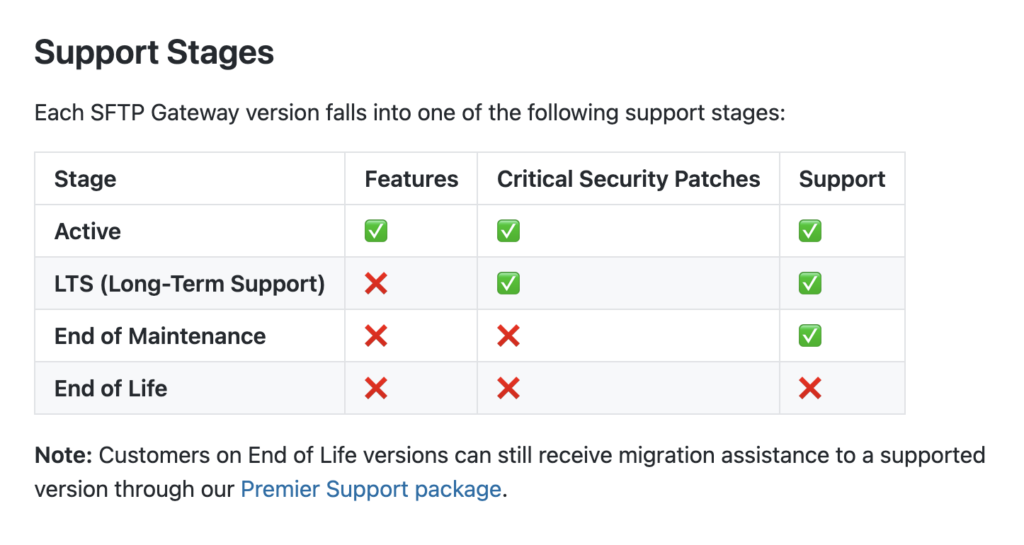
Every SFTP Gateway version sits in exactly one of four stages, defined in writing:
Active — The current version. Receives new features, security updates, and full customer support. This is where Thorn recommends staying if you want the latest fixes as soon as they ship.
Long-Term Support (LTS) — When a version is superseded by a new Active release, it moves to LTS. It keeps receiving critical security patches (CVEs), and the price doesn’t change. Your environment stays patched and stable without a forced feature upgrade or a budget conversation.
End of Maintenance — Security patches stop. Customer support is still available for questions and migration planning, so you’re not cut off, but you’re no longer protected against newly disclosed CVEs.
End of Life — The version is no longer supported and may be removed from the cloud marketplace listing.
This structure means a version’s status is stated plainly: it’s either getting patched or it isn’t, at every point in its lifecycle.
The Version Support Calendar Backs It Up
Alongside the four stages, Thorn is publishing the dates. The Version Support Calendar — maintained separately for AWS, Azure, and GCP — lists every released version, its current stage, and the exact dates it moves to LTS, End of Maintenance, and End of Life.
As of this writing, that means, for example, SFTP Gateway 3.8.3 is the current Active version across all three marketplaces. The Professional listing is in LTS, with critical patches guaranteed through June 2027, End of Maintenance until June 2028, and End of Life after that. Versions 3.1.0 through 3.5.1 are in End of Maintenance now, with a published End of Life date of September 2026.
A policy tells you the rules. A calendar tells you where you personally stand, today, against a real date on the schedule.
Why This Fits a Self-Hosted Architecture
This kind of transparency pairs naturally with a self-hosted deployment model. SFTP Gateway runs inside your own AWS, Azure, or Google Cloud account, which means the upgrade decision is yours: you choose when to move to a new version and can test it against your own change control process first. The published lifecycle and calendar give you the information; the self-hosted deployment gives you the ability to act on it on your own schedule.
What This Means Going Forward
Check the Version Support Calendar for your marketplace to see where your current version stands, how long it will continue to receive security patches, and when the next milestone arrives. As new CVEs come in and new versions ship, that calendar will be the reference point for understanding what any given update means for your environment.
Schedule a demo or reach out to support@thorntech.com with questions.
About Thorn Technologies
Thorn Technologies specializes in cloud-native file transfer solutions for enterprises. Our SFTP Gateway and StorageLink products serve organizations worldwide, delivering the security and reliability of traditional managed file transfer solutions with the flexibility and cost efficiency of modern cloud infrastructure.